Your TV is on the fritz and now you're wondering if you need to hop on down to the nearest TV store or hunt down an authorized repair center. While the Bond's TV Repair Center shut down in June 2026, our 72 years of experience has given us an idea of what is and what isn't going to be worth repairing.
Here are the 3 factors to determining whether your TV should be repaired or replaced:
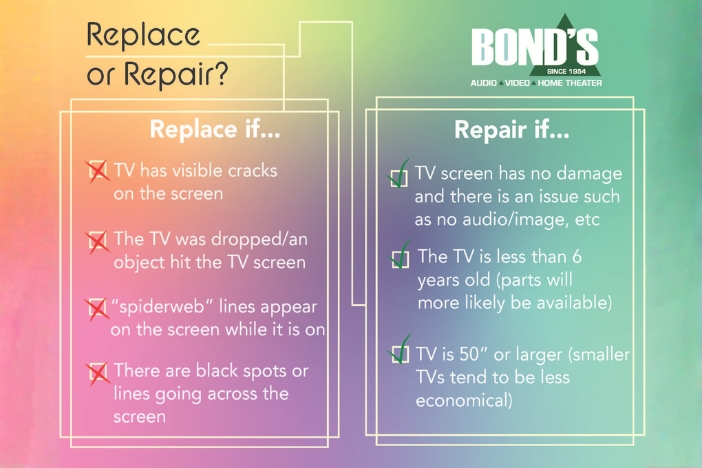
- TV Size: A TV that is smaller than 50" is likely going to be cheaper to replace than to repair. Most repairs cost around $250 with parts and labor. If your TV costs less or just a little bit more than $250, it is going to be better to invest in a new TV rather than dumping hundreds into a TV that isn't even worth the cost of repairs. Larger TVs costing $800+, especially high end models such as an OLED, are going to be worth fixing.
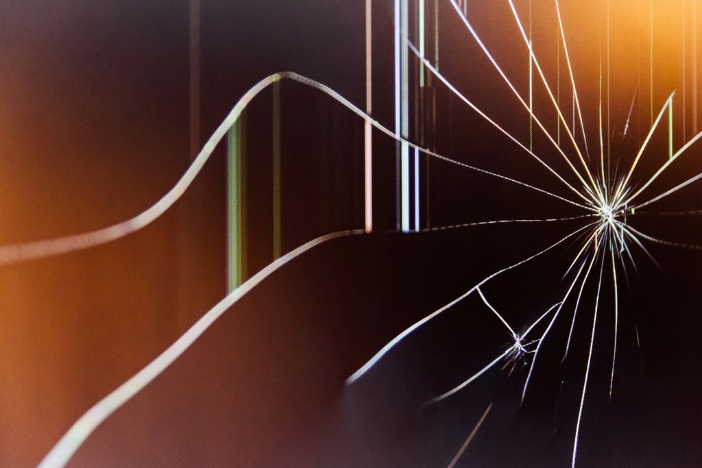
- TV Damage: If your TV sustained an impact on its screen, such as during a move to a new residence or from a toy thrown by a pet or child, the screen replacement is going to cost more than purchasing a new TV. The screen/panel is the most expensive part of the TV and manufacturers make it that way to encourage customers to purchase a new TV rather than repairing a broken screen.
- TV Model: Each type of TV has its own unique technology, which will determine what diagnoses are possible and how expensive these issues will be. For example, OLED TVs utilize a technology that is derived from organic material. This means the organic LEDs will degrade faster and are at risk of "burn in" or an afterimage. Burn in is often a result from a static image on the screen that leads to the LEDs in that portion of the screen to degrade faster than the LEDs around them. Another example is Samsung's proprietary technology the One Connect, utilized by the Frame and some of their NeoQLED TVs. The One Connect is a separate box containing all the connections/inputs. It comes with a long cord - the One Connect cable - that connects the TV to the box. This allows the TV to sit flush with the wall and gives users the option to place the box within a receptacle behind or away from the TV. The One Connect box has its own circuitry that can fail and sometimes the One Connect cable itself needs replacement.
The most common issue is circuit board failure. TVs typically have 3 circuit boards: the power supply board, main PCB circuit board and the Tcon board. If you don't have your TV connected to a surge protector, getting it connected to one should be your top priority. Power surges are the main culprit for taking out power supply boards; since the power supply board feeds the power to the PCB board, sometimes the PCB board will sustain damage from a power surge as well. Other common issues are backlight failure and panel/screen damage.
Take a look at the table below for an estimate of common repair costs:
| TV Symptoms | Most Common Diagnosis | Estimated Cost of Repair |
|---|---|---|
| Screen completely black or faded image on all or majority of the screen | Backlight failure | $300 for smaller TVs $450 for TVs 55"-70" $650 for TVs 75"-85" |
| Circular bright spots on screen | "Hot spots" caused by refractors on LEDs shifting/falling off. Best repair practice is to replace entire backlight system | $300 for smaller TVs $450 for TVs 55" or larger |
| Spider web cracks, impact marks, vertical stripes across screen, pixelation/color distortion | Panel/screen damage | $500 for 32"-49" TVs $700-$1,500 for 55"-75" normal LED TVs $2,000-$4,000 for 75"-85" or for high end TVs |
| Wifi not connecting | Wifi module failure | $250-$350 for most TVs |
| TV not powering on with or without blinking power light | Circuit board failure - likely a main PCB or power supply board | $250-$400 for most TVs $300-$500 for TVs with one connect |
| TV powering cycling on/off | Circuit board failure - likely a main PCB or power supply board | $250-$350 for most TVs |
While some of the TV symptoms like a crack in the screen are a clear sign your TV is doomed, some of the issues aren't always a clear indication of total failure. There may be a chance your TV is experiencing an issue that can be fixed through basic troubleshooting. Take a minute to review the following troubleshooting steps:
| Issue | Troubleshooting Steps |
|---|---|
| TV not powering on | Unplug TV for 60 seconds then plug back in to allow internal circuitry to reset. Check that the outlet is active and if using a surge protector, try resetting or replacing surge protector Make sure remote is sending signal to the TV; check batteries and ensure there are no signal obstructions. If using a universal remote, try switching to the original TV remote |
| TV not loading an app | Check for software updates on TV or app |
| TV has no image with sound or says "No connection/no signal" | Check that your source is powered on - if using a cable box try rebooting it Make sure the right input is selected |
Once you have determined whether your TV is worth repairing, your next step will be contacting the manufacturer to get a list of authorized repair centers in your area. If your TV is still under warranty, the manufacturer may request an official diagnosis from a certified technician before they reimburse the repair or issue a replacement.
If you're still not sure if your TV needs to be replaced, Bond's is happy to help you make the decision – and if it is time for a replacement, we'll help you find the TV that fits your lifestyle.
Now that you're in the market for a TV, deciphering what all the acronyms mean can be quite overwhelming. Here's a quick guide to the different TV technologies:
NeoQLED
Samsung Neo QLED uses thousands of precision-controlled Mini LEDs to create extraordinary contrast, exceptional brightness, and stunning color accuracy.
Instead of flooding the screen with light, Neo QLED directs light exactly where it's needed, producing:
- Deep, cinematic blacks
- Brilliant highlights with incredible detail
- Vibrant, true-to-life color
- Exceptional performance in bright living spaces
- Smooth, crystal-clear motion for sports, movies, and gaming
The result is a television that looks just as incredible during a sunny Austin afternoon as it does during movie night.
Whether you're hosting friends to watch the Longhorns, enjoying a quiet evening with family, streaming the latest series, or listening to music throughout your home, Samsung's advanced processing continuously optimizes every scene for exceptional clarity, color, and detail.
OLED
A conventional LED television uses a backlight that shines through an LCD panel. Even with advanced local dimming, light inevitably leaks into darker areas of the screen, reducing contrast and limiting image accuracy.
OLED eliminates this compromise entirely.
Instead of relying on a single backlight, every individual pixel in an OLED display creates its own light and can turn completely on or off independently. Because each pixel produces its own light, the display can create perfect blacks directly next to brilliant highlights without blooming or halo effects. This pixel-level control results in:
- Infinite contrast for exceptional depth and realism
- True blacks with no backlight bleed
- Exceptional color accuracy
- Wide viewing angles for large gathering spaces
- Outstanding HDR performance with breathtaking highlights
- Accurate, vibrant color reproduction
- Near-instant response times for sports and gaming
- Ultra-thin designs that complement luxury interiors
The result is a viewing experience that feels remarkably lifelike. Blacks are truly black—not dark gray. Colors appear richer and more accurate. Bright highlights stand out without washing out surrounding details, and every scene has incredible depth and realism.
Whether you're watching the latest blockbuster, cheering on the Longhorns, streaming Formula 1, or enjoying nature documentaries, OLED reproduces content exactly as filmmakers and creators intended.
MicroRGB
Unlike conventional LED televisions that rely on a white backlight—or even OLED displays that use organic light-emitting materials—Samsung's MicroRGB architecture uses microscopic red, green, and blue LEDs as the display's light source. Each color is generated directly, eliminating the need for traditional color filters while producing exceptional brightness, color purity, and long-term performance.
The result is an image that is incredibly vibrant, remarkably lifelike, and engineered to perform at the highest level in virtually any viewing environment.
Every scene feels more dynamic, every color more natural, and every detail more immersive.
Samsung R85H & R95H: Built for Extraordinary Homes
Samsung's MicroRGB lineup, including the R85H and R95H, is designed for homeowners who expect uncompromising performance from every aspect of their home.
Whether you're creating a dedicated media room, designing a luxury great room, or integrating a complete smart home ecosystem, these displays become the visual centerpiece of the entire experience.
Their sophisticated design complements modern architecture while delivering the kind of cinematic performance typically reserved for commercial reference displays.
When paired with professionally calibrated audio, intelligent lighting, and seamless automation, the result is an entertainment experience unlike anything available from conventional televisions.
MiniLED
At first glance, many televisions appear similar.
The difference is what's happening behind the screen.
Traditional LED televisions use larger backlights with limited precision, making it difficult to accurately balance bright highlights and dark scenes at the same time.
Samsung Mini LED technology dramatically increases the precision of the display by utilizing much smaller LEDs, allowing the television to manage light more effectively across the screen.
The result is:
- Improved contrast and shadow detail
- Brighter HDR performance
- More accurate color reproduction
- Better visibility in bright rooms
- Enhanced detail in both dark and bright scenes
- Smooth motion for sports and gaming
- Excellent performance for everyday viewing and premium home theaters
For many homeowners, Mini LED offers an outstanding balance of performance, value, and long-term reliability.
Meet Samsung's Mini LED Lineup
Samsung's 2026 Mini LED lineup includes the M70H, M80H, and flagship M90H, giving homeowners multiple options based on room size, viewing habits, and overall entertainment goals.
Samsung M70H
The M70H is an ideal entry point into Samsung's Mini LED technology.
Featuring Samsung's Mini LED Processor 4K, Pure Spectrum Color, 4K upscaling, and Motion Xcelerator, it delivers a significant upgrade over conventional LED televisions while maintaining exceptional value. It's an excellent choice for family rooms, bedrooms, and secondary entertainment spaces.
Samsung M80H
Stepping up to the M80H introduces enhanced gaming and AI-powered features, including Samsung Vision AI, Motion Xcelerator 144Hz, and AI picture enhancements designed to optimize content automatically. It's an outstanding option for homeowners who enjoy sports, gaming, and premium streaming experiences.
Samsung M90H
The M90H sits at the top of Samsung's Mini LED family, offering the largest screen options and the most immersive viewing experience for expansive great rooms, dedicated media rooms, and luxury living spaces. Designed for homeowners who want exceptional scale without compromising picture quality, it becomes the centerpiece of any entertainment system.
More Than a Television—A Complete AV Experience
A premium display is only one piece of a truly exceptional entertainment system.
Our team designs fully integrated home technology solutions featuring:
- Samsung Mini LED televisions
- Architectural surround sound
- Whole-home audio
- Outdoor entertainment systems
- High-performance networking
- Smart lighting
- Motorized shades
- Home automation
- One-touch control from your phone, remote, or touchscreen
Every system is custom engineered around your home, your lifestyle, and the way you entertain.
Professional Installation Makes the Difference
Even the best television performs better when it's professionally installed and calibrated.
We work with homeowners, architects, builders, and interior designers throughout Austin to create entertainment systems that look as impressive as they sound.
From concealed wiring and precision mounting to system programming and future-ready infrastructure, every installation is designed for lasting performance and effortless operation.